Wednesday, December 11, 2013


Thursday, October 24, 2013
Teeth whitening
There are 2 methods to choose from
1) In Office: It is a light enhanced technique done in clinic. It saves lots of time for the patient since the result is instant. Excellent option for busy people who want the result same day.
2) At home: The patient put the whitening gel himself at home in a pre- fabricated customized trays.It takes up to 21 days to get the final result.
Before doing any of them ,Dentist must check your teeth to observe any decays,stains and exposed dentin. This determines if there is potential sensitivity,treatment duration and expected result.The procedure for:
1) In office: A whitening gel is applied to your teeth .Photos of before situation are taken to compare the effectiveness after the treatment. Gum and lips are protected and a coat of hydrogen peroxide is applied on teeth for 20 minutes to be removed for another coat since hydrogen peroxide gets deactivated in max 30 mins. Up to 4 coats can be applied depending on each situation.
2) At home: Two whitening trays are delivered to the patient for use at home. A whitening gel is given to be applied home.The whitening gel can be applied for 30 minutes every night before bedtime up to 21 days.
Now to get the best result, I use my own protocol in my practice. Most of the time the two techniques are recommended. I always ask the patient to keep the at home trays for later touch ups(maintenance). Touch ups differ from case to case.It could be every 6 months or every one year. It depends on each patient situation and life style.
Pictures are for real patient of mine
Dr RAMI CHAYAH DMD
Contact info: dental.spa@hotmail.com
tel 00961 7 754991
Thursday, January 24, 2013
what are minimal invasive burs?
To give you a glimpse about minimal invasive burs, I will first explain the concept. Nowadays, tooth preparation techniques are totally different. In the presence of bonding materials,no need anymore to prepare tooth tissue according to Black classification.
Minimal invasive dentistry is gentle and conservative when it comes to removing carious lesions. You only remove soft pigmented dentin that does not sound. In class one,you prep teeth following carious fissures and pits only.You use the smallest bur available that can remove that carious spot and still respect anatomy.In figure 1, you see a set of burs used for minimal invasive preparations in my practice when treating carious lesions.
 Figure 1
Companies have shifted towards being conservative by producing a whole line of burs dedicated towards minimal invasive tooth preparation. SHOFU for example included a whole section of minimal invasive burs with clear demonstrative illustrations Figure 2,3,4,5&6
 Figure 2
 Figure 3
 Figure 4
 Figure 5
 Figure 6
Finishing or just beveling the prepared sites, you can use a set of fine small finishing burs specifically selected to just round any sharp edges left after preparation.These same burs can be used for finishing the composite after placement.In Figure 7, 8&9 you can see a set of finishing burs from German company Schezer used in my practice for this purpose.
 Figure 7
 Figure 8

Figure 9
Minimal invasive dentistry is gentle and conservative when it comes to removing carious lesions. You only remove soft pigmented dentin that does not sound. In class one,you prep teeth following carious fissures and pits only.You use the smallest bur available that can remove that carious spot and still respect anatomy.In figure 1, you see a set of burs used for minimal invasive preparations in my practice when treating carious lesions.

Companies have shifted towards being conservative by producing a whole line of burs dedicated towards minimal invasive tooth preparation. SHOFU for example included a whole section of minimal invasive burs with clear demonstrative illustrations Figure 2,3,4,5&6


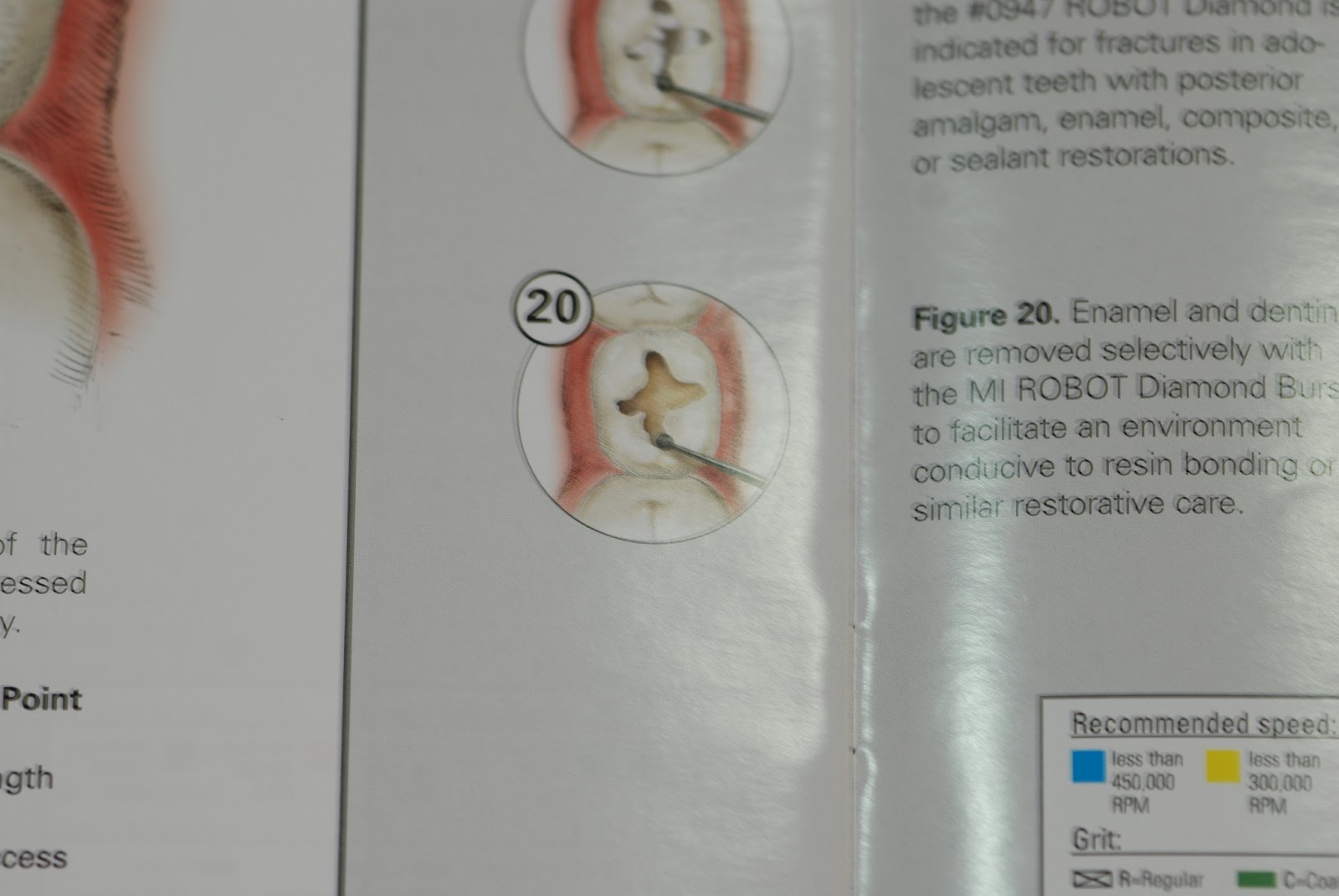

Finishing or just beveling the prepared sites, you can use a set of fine small finishing burs specifically selected to just round any sharp edges left after preparation.These same burs can be used for finishing the composite after placement.In Figure 7, 8&9 you can see a set of finishing burs from German company Schezer used in my practice for this purpose.


Figure 9
Sunday, October 7, 2012
Previously I blogged about oral sedation and talked about some medications. In this blog however, I will talk more about general benefits of oral sedation and its application in dentistry.
If dentist apply oral sedation in his office ,he can:
Spectrum of sedation has 3 phases
through special residency training and got special licence.
Let us mention some of the most popular oral sedatives dentists can use:
Generic Trade
Diazepam Valium
Zalepon Sonata
Triazolam Halcion
Hydroxyzine Atarax or Vistaril
Lorazepam Ativan
Nitrous Oxide Laughing gas
In every dental office using oral sedatives, Romazicon (flumazenil) 10ml injection 1mg/10ml or 0.1mg/ml should be available to reverse the effect of bezos in case of over sedation(overdose).
Protocols: Usually pill can be taken one to two hours before procedure. If pill will be taken home, somebody should accompany the patient and he should be informed.
A dose at night can be given as well one day before the appointment depending on the case.
Valium(Diazepam) is usually given at bedtime . Dose depends on some factors like age, BMI, history and other medications.
Patients taking CNS depressants or other serious medications should be treated carefully. You should avoid prescribing Valium to all patients with the same dosage. Please seek consultation from experts before prescribing any medicine
in critical medical cases.
If you use oral sedatives in your office, it is recommended to track and monitor vital sign during the whole treatment appointment.Pulse oximeter blood pressure unite is necessary in this regard.
If dentist apply oral sedation in his office ,he can:
- Increase the quality of his procedures
- Increase the quantity of treatments
- Have more accepted treatment plans
- Decrease stress for the patient
- Complex big cases patients
- Those who are allergic to Anesthesia
- Phobic,Anxious and Fearful patients
- Sever Gag reflex patients
- Post operative sensitive patients
Spectrum of sedation has 3 phases
- Minimal sedation
- Moderate sedation
- Deep sedation
through special residency training and got special licence.
Let us mention some of the most popular oral sedatives dentists can use:
Generic Trade
Diazepam Valium
Zalepon Sonata
Triazolam Halcion
Hydroxyzine Atarax or Vistaril
Lorazepam Ativan
Nitrous Oxide Laughing gas
In every dental office using oral sedatives, Romazicon (flumazenil) 10ml injection 1mg/10ml or 0.1mg/ml should be available to reverse the effect of bezos in case of over sedation(overdose).
Protocols: Usually pill can be taken one to two hours before procedure. If pill will be taken home, somebody should accompany the patient and he should be informed.
A dose at night can be given as well one day before the appointment depending on the case.
Valium(Diazepam) is usually given at bedtime . Dose depends on some factors like age, BMI, history and other medications.
- If age >or = to 65,then the dose ranges from 0 to 2.5mg
- If BMI >or= to 30,then the dose ranges from 5 to 10mg
Patients taking CNS depressants or other serious medications should be treated carefully. You should avoid prescribing Valium to all patients with the same dosage. Please seek consultation from experts before prescribing any medicine
in critical medical cases.
If you use oral sedatives in your office, it is recommended to track and monitor vital sign during the whole treatment appointment.Pulse oximeter blood pressure unite is necessary in this regard.
Tuesday, September 4, 2012
T-scan computerized occlusal analysis system
T-Scan® III
computerized occlusal analysis
The only clinical diagnostic device available that senses and analyzes occlusal contact forces to quantify whether a patient's bite is balanced

Thursday, June 14, 2012
Where are we now regrading the treatment of periodontitis?
Through the past decades, it was common to treat periodontitis,periodontal pockets and bone loss, through the use of two modalities:
1) scaling and root planning
2) flaps and osseous remodeling

It was evident that the upper two modalities were unpredictable regrading the regenration of bone,fibers and the attachment around the teeth. Although scaling and root planning eliminate the bacteria from around the teeth, the long epithelium tissue would grow in around the tooth before the bone can make its regeneration,thus preventing the bone and surrounding tissue from rebuilding back around the teeth.

Nowadys, a third modality has been introduced to the bouquet;the LANAP
The LANAP (Laser Assisted New Attachment Procedure) allows removal of the inflamed epithelium,cleaves bond between calculus and root surface and kills biofilm.Thus scaling and root planning becomes effective. The final pass with the LANAP laser stimulates osseous regenration and leads to the formation of a fibronectin clot.

According to John chrispens DDS,the Laser for use in the LANAP procedure is the Nd:YAG and namely the periolase MVP-7.2.
The patient is asked not to brush in the area for one week post LANAP therapy.
Each laser works within a specific wavelength. Nd:YAG absorbes within the range of heme(darker colors),therefore penetrates into the tissue.
The Diode laser uses heat,therefore burns the tissue and penetrates only a short distance into the gingival sulcus before causing damage to the tissues. The CO2 and Er:YAG are absorbed by H2O, which is at the surface of oral tissues and do not penetrate into the gingival sulcus. Therfore, they have little effect on the biofilm in areas greater than 2mm subgingivally. The goal of the LANAP is not biofilm control but regenration.

Some periodontists contradict this formula. They suggest a membrane to stop epithelial cells from growing down into the socket and give bone and fibroblasts a chance to grow up.They say the laser will de-epithelialize the pocket but the epithelium will still grow back.
The LANAP protocol:
A) Perio probe indicates excesssive pocket depth
B) Laser radiation vaporizes bacteria, diseased tissue, pathologic proteins, and alerts the practioner to the presence of tartar.
C) Ultrasonic scaler and special hand instruments are used to remove root surface accretions.
D) Laser is used to form a gel-clot containing stem cells from bone and Periodontal ligaments.
E) Reattachment of rete ridges to clean root surface, with a stable fibrin clot at the gingival crest to create a closed system.
F) occlusal trauma adjusted
G) New attachment is regenerated
1) scaling and root planning
2) flaps and osseous remodeling

It was evident that the upper two modalities were unpredictable regrading the regenration of bone,fibers and the attachment around the teeth. Although scaling and root planning eliminate the bacteria from around the teeth, the long epithelium tissue would grow in around the tooth before the bone can make its regeneration,thus preventing the bone and surrounding tissue from rebuilding back around the teeth.

Nowadys, a third modality has been introduced to the bouquet;the LANAP
The LANAP (Laser Assisted New Attachment Procedure) allows removal of the inflamed epithelium,cleaves bond between calculus and root surface and kills biofilm.Thus scaling and root planning becomes effective. The final pass with the LANAP laser stimulates osseous regenration and leads to the formation of a fibronectin clot.

According to John chrispens DDS,the Laser for use in the LANAP procedure is the Nd:YAG and namely the periolase MVP-7.2.
The patient is asked not to brush in the area for one week post LANAP therapy.
Each laser works within a specific wavelength. Nd:YAG absorbes within the range of heme(darker colors),therefore penetrates into the tissue.
The Diode laser uses heat,therefore burns the tissue and penetrates only a short distance into the gingival sulcus before causing damage to the tissues. The CO2 and Er:YAG are absorbed by H2O, which is at the surface of oral tissues and do not penetrate into the gingival sulcus. Therfore, they have little effect on the biofilm in areas greater than 2mm subgingivally. The goal of the LANAP is not biofilm control but regenration.

Some periodontists contradict this formula. They suggest a membrane to stop epithelial cells from growing down into the socket and give bone and fibroblasts a chance to grow up.They say the laser will de-epithelialize the pocket but the epithelium will still grow back.
The LANAP protocol:
A) Perio probe indicates excesssive pocket depth
B) Laser radiation vaporizes bacteria, diseased tissue, pathologic proteins, and alerts the practioner to the presence of tartar.
C) Ultrasonic scaler and special hand instruments are used to remove root surface accretions.
D) Laser is used to form a gel-clot containing stem cells from bone and Periodontal ligaments.
E) Reattachment of rete ridges to clean root surface, with a stable fibrin clot at the gingival crest to create a closed system.
F) occlusal trauma adjusted
G) New attachment is regenerated
Subscribe to:
Posts (Atom)